The China Central Asia Summit has become a crucial diplomatic moment as Beijing moves to strengthen its economic and strategic influence in the region. Chinese President Xi Jinping’s visit to Kazakhstan highlights how Central Asia has become an important arena for global competition involving China, Russia, and the United States.
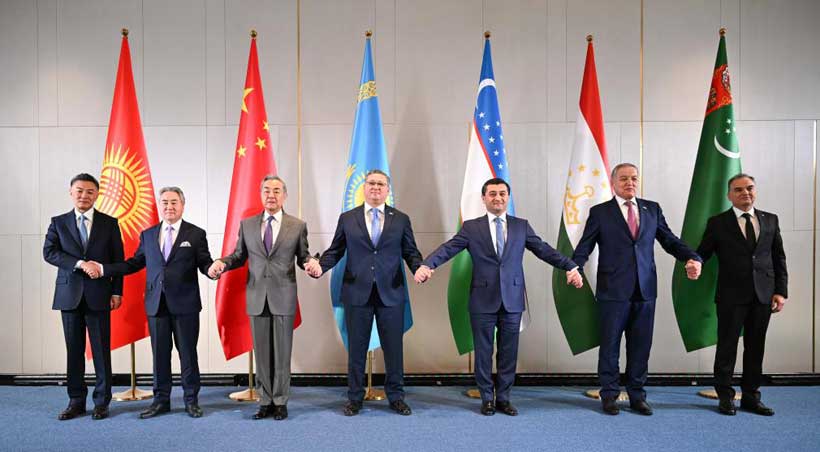
Leaders from Kazakhstan, Kyrgyzstan, Tajikistan, Turkmenistan, and Uzbekistan gathered in Astana for the high-level meeting with Xi. The summit reflects China’s growing ambition to deepen partnerships with Central Asian states while reshaping the region’s economic and geopolitical landscape.
China Central Asia Summit Strengthens Regional Ties
The China Central Asia Summit is designed to strengthen cooperation between Beijing and the five Central Asian republics. Xi Jinping arrived in Kazakhstan ahead of the meeting to hold bilateral discussions with President Kassym-Jomart Tokayev and other senior officials.
The gathering follows the first China Central Asia Summit held in Xi’an in 2023. Since then, the partnership has expanded rapidly through trade agreements, infrastructure projects, and investment initiatives.
During the summit, Xi is expected to outline plans for deeper economic collaboration and discuss key regional challenges. Topics likely include trade development, energy cooperation, and regional stability.
Chinese officials say the summit reflects a shared commitment among the six nations to promote development and maintain stability in Central Asia. For China, the region offers a critical strategic link connecting Asia with Europe and the Middle East.
China Central Asia Summit Highlights Strategic Importance
The China Central Asia Summit also sends a strong signal about Beijing’s strategic priorities. Analysts say Xi’s participation shows how seriously China views its relationship with Central Asian nations.
Central Asia holds vast reserves of oil, uranium, natural gas, and rare earth minerals. These resources make the region vital for China’s long-term economic and energy security.
At the same time, the region plays a key role in China’s Belt and Road Initiative. This massive infrastructure program aims to build highways, railways, and ports linking Asia, Europe, and Africa through major trade corridors.
One project expected to feature prominently in discussions is the planned railway connecting China’s Xinjiang region with Uzbekistan through Kyrgyzstan. Valued at around eight billion dollars, the railway is scheduled to begin construction soon and could be completed by 2030.
The route would create a faster trade connection between China and Central Asia while reducing reliance on transport routes that pass through Russia.
China Central Asia Summit and Global Power Competition
The China Central Asia Summit also reflects broader geopolitical competition in the region. Central Asia has historically been within Russia’s sphere of influence, largely due to its shared Soviet past.
Millions of Central Asian citizens still work in Russia, and Moscow remains a key security partner through alliances such as the Collective Security Treaty Organisation.
However, China’s economic presence has expanded rapidly in recent years. Over the past three years, Beijing has overtaken Russia to become the largest trading partner for all five Central Asian republics.
At the same time, the United States has attempted to strengthen relations with the region through its own diplomatic framework known as the C5+1 format. This initiative brings together the five Central Asian countries with US leaders to discuss economic and security cooperation.
Trade tensions between Washington and several Central Asian nations may now influence that relationship. Recent tariff policies from the United States have affected exports from countries including Kazakhstan, Kyrgyzstan, Tajikistan, Turkmenistan, and Uzbekistan.
Chinese officials have used these tensions to portray Beijing as a more reliable economic partner for the region.
China Central Asia Summit Reflects Growing Economic Ties
Economic links between China and Central Asia have expanded dramatically. Today, China is the largest trading partner for each of the five republics.
Kazakhstan, the region’s largest economy, imports billions of dollars in goods from China each year while exporting large quantities of energy and raw materials. Similar trade patterns exist across Uzbekistan, Kyrgyzstan, Tajikistan, and Turkmenistan.
China has also invested heavily in infrastructure and energy projects across the region. In Kazakhstan alone, Chinese investment commitments are estimated to reach more than twenty-six billion dollars.
For Central Asian countries, partnership with China offers access to large markets, advanced technology, and major infrastructure development.
China Central Asia Summit Shapes the Region’s Future
The China Central Asia Summit illustrates how the region has become a strategic crossroads for global powers. While Russia continues to maintain security ties, China now dominates trade and investment.
Meanwhile, the United States is seeking ways to expand its influence through diplomacy and economic engagement.
For Central Asian leaders, balancing these competing powers remains a key priority. By strengthening ties with multiple partners, they hope to secure economic development while maintaining political independence.
As Xi Jinping meets the region’s leaders in Astana, the Central Asia Summit signals that Central Asia will remain central to the evolving geopolitical and economic order shaping Eurasia.