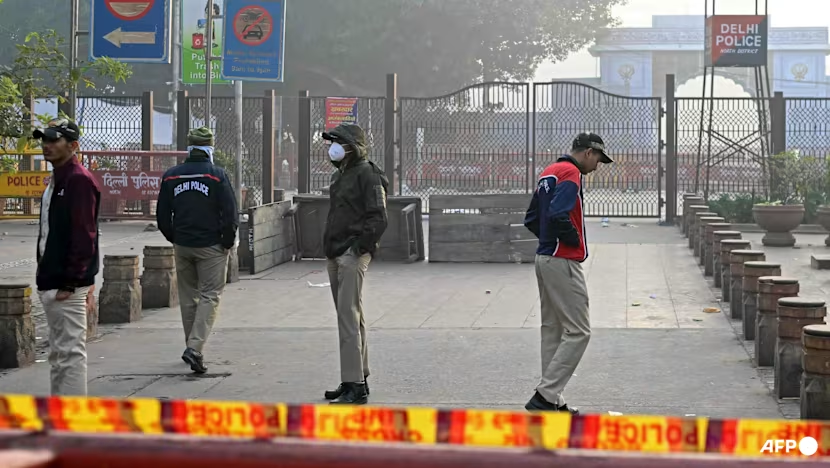
Indian police have launched sweeping raids in the disputed Kashmir region targeting the banned Islamist political party Jamaat-e-Islami, days after a deadly explosion in New Delhi. The blast, which occurred on November 10 near the historic Red Fort in Old Delhi, resulted in at least 12 fatalities. While there has been no official confirmation linking the raids to the explosion, the police actions mark a significant security operation following the attack, which the Indian government has described as a “heinous terror incident.”
The raids, which began on Wednesday, have been carried out across various districts in the Indian-administered part of Kashmir, including Awantipora, Bandipora, Ganderbal, Shopian, and Sopore. Local police forces have stated that the operations targeted the Jamaat-e-Islami (JeI) party, which has been banned by the government since 2019. The government’s decision to outlaw the party was based on claims that it operated as an “unlawful association” and had connections to militant groups.
Officers have reported conducting “extensive raids at multiple locations” aimed at dismantling what they describe as a terror ecosystem and its supporting structures. In Bandipora, police mentioned that they had seized “incriminating material” during the operations. Meanwhile, Sopore police revealed that over 30 locations were searched in their efforts to dismantle networks linked to Jamaat-e-Islami. The raids also extended to Al-Falah University in Faridabad, on the outskirts of New Delhi, and included a demolition in Pulwama, a district in Kashmir. While the reasons for the demolition have not been explained, similar actions have been taken in the past against individuals accused of involvement in militant attacks.
The National Investigation Agency (NIA), India’s primary anti-terrorism body, is leading the investigation into the blast in New Delhi. The Indian government has pledged to bring those responsible, along with their collaborators and sponsors, to justice. However, details about the perpetrators remain sparse, and it is unclear whether the attack was orchestrated by a domestic group or had international links.
There has been speculation in the media about a possible connection between the Delhi explosion and a string of arrests made just hours before the attack. Police had seized explosive materials and assault rifles from those arrested, who were reportedly linked to Jaish-e-Mohammed (JeM), a Pakistan-based militant group affiliated with Al-Qaeda. Additionally, the group Ansar Ghazwat-ul-Hind, a Kashmir-based offshoot of JeM, is believed to have been involved in the operation.
According to Jammu and Kashmir police, investigations into these arrests had revealed a “white-collar terror ecosystem,” involving radicalized professionals and students in contact with foreign handlers from Pakistan and other countries. These findings suggest a network of individuals with higher education backgrounds and technical skills, operating covertly to support militant activities.
The deadly explosion in New Delhi marks the most significant security incident since April 22, when 26 civilians, mostly Hindus, were killed in a terrorist attack at the tourist site of Pahalgam in Kashmir. This attack had sparked violent clashes with Pakistan, escalating tensions between the two nations.
While the full details of the explosion and its potential links to the broader terror ecosystem are still emerging, the raids in Kashmir reflect India’s ongoing efforts to counter militant activity in the region, particularly in the context of the larger geopolitical struggle over Kashmir, a territory claimed by both India and Pakistan since their independence in 1947.