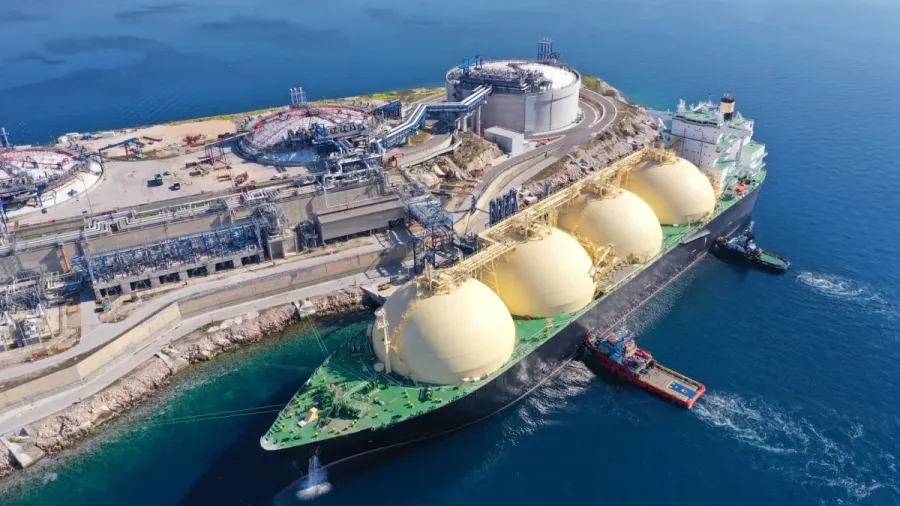
Japan LNG resales are climbing to record levels as domestic demand keeps shrinking, pushing utilities and trading houses to sell more cargoes abroad. New data cited by Japan Organisation for Metals and Energy Security (JOGMEC) shows fiscal year 2024 resales rose by nearly 15% from the previous year, even as Japan’s own LNG consumption remained far below past peaks.
The shift matters because Japan has long framed LNG investment as an energy security priority. Yet the same companies now exporting more volumes are also signing fresh long term purchase deals and lobbying overseas governments to expand gas production and export capacity.
Japan LNG resales rise as domestic use stays well below 2018
Japan LNG resales surged while local consumption only edged up slightly and still sits about 20% below FY2018 levels. The JOGMEC survey indicates that around 40% of LNG handled by Japanese firms is now exported, a sharp jump from 16% in FY2018.
That widening gap between procurement and domestic need is changing how Japanese players operate. Instead of acting mainly as end users, they are increasingly behaving like global LNG traders, aiming to capture margins by redirecting cargoes to higher priced markets.
Why Japanese companies are selling more LNG abroad
Japan LNG resales are being fuelled by two overlapping trends. First, structural demand is weakening at home as efficiency improves, renewables expand, and more nuclear capacity returns. Second, Japanese firms have built contract portfolios that allow destination flexibility, meaning cargoes can be resold when local demand or prices do not justify delivery.
Analysts cited in the report argue that the export push complicates the energy security argument used to justify new upstream projects and LNG infrastructure. Research referenced in the story points to Japan’s role in supporting Australian LNG export growth and to Japanese opposition in the United States to a pause on new LNG export facilities, on the grounds that such moves could threaten supply stability.
However, critics say the rapid growth in external trade alongside falling domestic demand suggests these investments increasingly serve trading and commercial expansion goals rather than purely securing Japan’s own needs.
Australia volumes, profits, and a growing Asia resale focus
Japan LNG resales have increasingly targeted South and Southeast Asia, where demand growth and market development can create opportunities for cargo placement. A report referenced from the Institute for Energy Economics and Financial Analysis (IEEFA) said Japanese utilities are buying more LNG than required domestically and then pushing volumes into overseas markets.
The story cites estimates that in 2024 Japan resold roughly $7.83b to $9.96b worth of Australian LNG, with profits potentially exceeding $712m. It also notes FY2024 resales exceeded Japan’s combined imports from Australia and Malaysia, and surpassed the total LNG output of Russia, underscoring the scale of resale activity.
Nuclear restarts and renewables set to cut LNG demand further
Japan LNG resales could rise again as domestic demand faces more headwinds from reactor restarts and renewable buildout. Tokyo Electric Power plans to restart its 1.35GW Kashiwazaki Kariwa Unit 6 in March 2026, a move estimated in the report to displace roughly one million tonnes of LNG demand. Another 1.1GW reactor is expected online by December 2026.
With each restart, gas fired generation can lose market share, leaving utilities with excess contracted volumes. That excess is then more likely to be sold into the region, especially when contracts permit flexible destinations.
New long term LNG deals continue despite weaker local demand
Japan LNG resales are rising even as Japanese firms continue to sign new supply agreements. The report says Japanese companies signed 10.5 million tonnes per annum (MTPA) of new sales and purchase agreements last year, mostly linked to US producers, often structured with destination flexibility that supports trading.
In February 2026, JERA agreed to buy 3 MTPA of LNG from QatarEnergy through 2054, adding another major long dated commitment to its portfolio.
At the policy level, the Ministry of Economy, Trade and Industry continues to encourage companies to procure 100 million tonnes of LNG annually and to take stakes in overseas projects, even as domestic demand trends lower.
Risks for Japan LNG resales as prices soften and costs rise
Japan LNG resales are not a guaranteed profit engine. The report warns that falling global LNG prices and rising US feedgas costs could squeeze margins, especially in an oversupplied market. It also highlights financial pressure already visible in performance metrics, noting that JERA’s Fuel Business net earnings have dropped 46% since 2022.
Some companies are trying to hedge that risk by investing in US upstream gas and power assets. The story notes Japanese companies have invested $10.8b in US oil and gas production over the past two years, and references a US Japan trade deal announced in February 2026 that includes $33b for 9.2GW of gas fired power in Ohio.
Even so, the report cautions that as Japanese utilities move deeper into trading, they face stiffer competition from other global suppliers and greater exposure to market swings. If the global LNG market remains well supplied, the same strategy that boosted earnings during tight periods could deliver lower returns, or even losses, when prices weaken.
Japan LNG resales hit record as home demand slips


Latest from Blog